One qubit, two specialized jobs
MIT researchers have designed a superconducting qubit around a practical engineering principle: a component that stores delicate information should not carry every burden of communication, control, and measurement. Their arm qubit divides those duties between two connected operating modes. A data mode protects the quantum state. An arm mode connects that state to neighboring circuit elements and readout hardware.
Physical Review Applied published the peer-reviewed design on September 2, and MIT described the work on September 3. Jeremy Kline led the research with Alec Yen, Stanley Chen, and Kevin O’Brien at MIT’s Research Laboratory of Electronics. The group has produced a detailed circuit model and numerical simulations. It has not fabricated or measured an arm qubit, a distinction that sets the proper boundary around every performance claim.
Within that boundary, the results give quantum engineers a serious design candidate. Quantum processors need qubits that preserve information long enough to calculate, interact fast enough to complete error-correction cycles, and connect to measurement hardware without absorbing destructive noise. Existing superconducting designs can perform each task well. Combining all three within a scalable circuit remains one of the field’s central engineering problems.
Why communication can damage stored information
A quantum state loses useful information through decoherence. Material defects, electromagnetic noise, unwanted interactions, and energy leaking into the surrounding circuit can all contribute. Engineers measure a qubit’s useful lifetime in relation to the time required for gates and readout. A processor gains room for more computation when it completes accurate operations before noise overwhelms the state.
Strong connections help qubits exchange information and support fast measurements. Those same connections can expose the data-bearing component to new error channels. Weak connections protect the state but slow the operations that a fault-tolerant machine must repeat at high frequency. Engineers have responded with tunable couplers, filters, resonators, and qubit designs that favor either coherence or interaction strength.
The arm qubit assigns the conflicting tasks to separate modes inside one coordinated circuit. Its fluxonium-like data mode favors long coherence and strong nonlinearity. Its transmon-like arm mode has a larger capacitance budget for connections. The data mode can remain less exposed while the arm mode reaches the couplers and resonators that perform gates and measurements.
The quarton provides a controlled connection
Separating the modes only helps if engineers can connect them without recreating the original problem. The MIT design uses a circuit element called a quarton coupler. The quarton creates a strong nonlinear interaction between the data and arm modes while suppressing the linear mixing that could pull stored information into the surrounding circuit.
Nonlinear coupling lets the circuit respond according to the quantum state rather than behaving like two ordinary oscillators joined by a fixed connection. The paper reports cross-Kerr interactions of several hundred megahertz between relevant components. Those interactions allow the arm mode to influence a gate or readout process while the data mode retains a degree of isolation.
The authors model two arm qubits connected through a transmon coupler. A microwave pulse drives a conditional operation on that middle component, producing a controlled-Z gate between the data modes. This gate is a standard building block for creating entanglement. The proposed circuit uses capacitive connections, which fit established superconducting manufacturing methods and avoid a more elaborate web of control elements.
The simulated performance reaches an important range
The final journal abstract reports a simulated controlled-Z gate infidelity of 8.7 times 10 to the minus 5 in 17 nanoseconds after the model includes decoherence. That corresponds to a modeled fidelity above 99.99 percent under the paper’s assumptions. The simulation also holds the unwanted always-on interaction below 0.4 kilohertz. Fast intended gates and weak idle interactions form a valuable combination for error-corrected circuits.
The authors estimated echo coherence times above 380 microseconds for the data modes under their selected material-loss assumptions. Their robustness study varied circuit parameters with a 5 percent standard deviation, then adjusted the drive amplitude for each simulated device. Ninety percent of those modeled samples stayed below 1.8 times 10 to the minus 4 in coherent gate error for a 15-nanosecond pulse.
These figures describe a numerical device rather than laboratory performance. The model uses assumed dielectric quality, noise behavior, circuit parameters, calibration, and fabrication variation. Real chips introduce junction defects, microwave crosstalk, packaging modes, thermal effects, and drift that a simulation may miss. The work provides a demanding experimental target. It does not report a record set by operating hardware.
Readout receives the same codesign treatment
Quantum error correction needs measurements that finish fast and preserve the information required for the next cycle. The arm qubit connects its arm mode to a readout resonator while keeping the data mode less exposed to that resonator. The modeled readout uses the state-dependent frequency of the arm mode to separate measurement outcomes.
The authors report rapid state assignment in their simulations and a Purcell-limited lifetime of 167 milliseconds without a separate Purcell filter. Purcell decay occurs when a qubit loses energy through the measurement circuit. The architecture suppresses that path because the data mode mixes only weakly with the arm mode. Removing a filter could reduce component count if experiments confirm the modeled protection.
The design also allows engineers to tune the arm mode away from the resonator outside the measurement window. The paper calculates a shot-noise dephasing limit of 15.8 milliseconds for one modeled configuration. That mechanism targets stray photons that remain in the readout system and disturb the data mode after a measurement.
Better physical qubits can reduce the correction burden
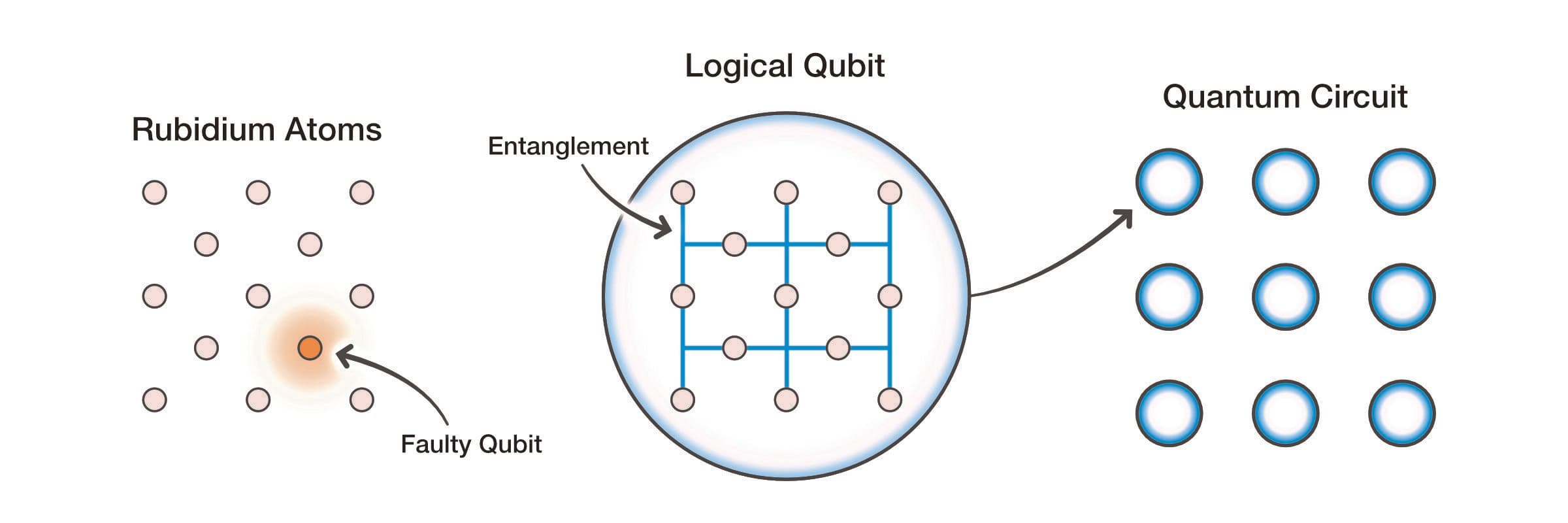
Fault-tolerant quantum computers will encode each dependable logical qubit across many physical qubits. The required number depends on the code, connectivity, target algorithm, and physical error rates. Small improvements near a correction threshold can change the scale of the machine needed for a useful calculation. Faster cycles can also identify errors before decoherence creates a larger cluster of faults.
The arm qubit attacks that overhead at the hardware level. It seeks low gate error, fast measurement, long coherence, and two-dimensional connectivity within the same circuit family. The paper estimates that four coupler connections and one readout connection would consume about two thirds of the arm mode’s modeled capacitance budget. That leaves a plausible route to a surface-code-style lattice rather than a device that works only as an isolated pair.
Quantum progress needs this kind of codesign. Improvements in algorithms cannot compensate for hardware that loses information before the calculation ends. Hardware improvements also need decoders, control software, cryogenic systems, and classical processors capable of acting on error data in real time. AI can assist with calibration and anomaly detection, while quantum hardware may open new scientific workloads. Neither field benefits from claims that skip the physical evidence.
Fabrication is the next decisive test
The MIT team plans to fabricate the arm qubit, characterize its modes, and integrate it into a working system. Experiments must test coherence, gate fidelity, readout, leakage, crosstalk, calibration stability, and manufacturing yield. Multi-qubit trials must then show whether the proposed isolation survives a denser network of couplers and resonators.
A weak experimental result would still provide useful information. It could expose an overlooked loss mechanism or show which circuit parameter needs revision. Scientific progress depends on building promising designs, measuring where they fail, and carrying those lessons into the next device. Fear of an imperfect first chip would freeze the field before engineers can learn which parts of the model describe reality.
The present evidence supports investment in that experimental program. The arm qubit unites known superconducting concepts in a circuit designed around the full demands of error correction. Its simulated numbers warrant attention, its architecture gives researchers testable hypotheses, and its remaining uncertainty has a clear remedy: fabricate the device and measure it.